
G-Force: Building Relationships, Restoring Heritage, Delivering with Confidence
When Paul Glassenbury founded G-Force Building and Consulting in August 2009, it began as a home-based operation—just Paul, backed by a professional background in building design and project management, and a clear idea of what the construction experience should feel like for clients. Sixteen years later, that philosophy has carried the business from a solo start-up to a multi-disciplinary builder of roughly 46 staff, operating from a purpose-built office the company designed and constructed in 2018—an office the team is already beginning to outgrow.
From the beginning, G-Force has been guided by a straightforward but powerful premise: do the right thing by people, deliver great service, and build quality projects while being genuinely enjoyable to deal with. Paul credits that consistency—more than any single market segment or project type—as the reason the company has evolved steadily year after year. It’s also why G-Force has developed a reputation not only as a capable builder, but as a relationship-led partner that clients, consultants, and subcontractors want on their projects.
Unlike many builders that specialise strictly in either residential or commercial work, G-Force has built its capability across both—and then added a third dimension that has become a signature strength: heritage conservation. Early on, the company focused heavily on government and institutional work, including schools, council buildings, and other local government projects.
At the same time, heritage work remained a strong personal passion for Paul, and one that aligned naturally with the skills and standards the company wanted to be known for. Over time, G-Force has become a significant player in Adelaide’s heritage sector, working on some of the city’s most recognised historic assets, including the South Australian Museum, Art Gallery, Government House, and Parliament House.
That heritage capability also became a springboard into residential work. As Paul put it, “If we can work at Government House, we can probably work anywhere.” From there, the company expanded into residential projects—particularly mid-to-high-end renovations and extensions—often delivered in partnership with designers and architects who already hold the primary client relationship and bring G-Force in once plans are ready.
While G-Force does the occasional new build, these are typically one-off, custom designs. Two of the three new homes the company has built were for wheelchair-bound clients requiring highly specialised, accessibility-driven solutions—work that reflects both technical sensitivity and a values-first approach to building.
Across every project type, Paul’s emphasis returns to the same core idea: construction is ultimately about people. G-Force doesn’t position itself as a builder that simply competes on price or promises—it aims to be the builder that clients actively want involved. The team encourages a mindset where clients approach G-Force early and say, “We really want you on this project,” because they know the experience will be easier, clearer, and better managed. And while G-Force can’t win every job, Paul noted that a meaningful signal of success is hearing from clients who didn’t choose them the first time—only to later say they wish they had, after living through frustrations elsewhere.
One heritage project in particular captures both the complexity of G-Force’s work and the trust placed in the company by major stakeholders. Completed roughly a year ago, the Urrbrae Gatehouse project became a highly visible story in Adelaide. The state government planned to widen a major intersection, and a heritage building on the corner was set to be demolished. Community outrage followed, with protests calling for preservation. The eventual compromise solution was bold: move the building. G-Force dismantled the 140-year-old bluestone structure stone-by-stone and brick-by-brick, then rebuilt it approximately 500 meters away, placing every component back in its original position.
It was widely covered in the media and described as Adelaide’s biggest jigsaw puzzle—a collaboration involving state government and a local university, and a clear example of the precision and stewardship that heritage work demands.
Internally, Paul describes culture as the engine of the business. G-Force has retained a high number of long-term employees—something Paul says is unusual in construction—adding that they “don’t lose a lot of staff that we don’t want to lose.” With the managing director no longer deeply embedded in day-to-day project delivery, the company depends on a team that is engaged, motivated, and aligned with G-Force’s values.
The belief is simple: when people enjoy their work, feel respected, and buy into the company’s standards, they deliver better outcomes for clients. Those outcomes then lead to repeat work, referrals, and the steady, sustainable growth G-Force has experienced.
Values are not treated as wall art at G-Force—they are operational. The company places strong emphasis on safety, quality, and environmental management and has recently secured ISO accreditation in those areas. Paul noted how much the industry has shifted over the past few decades, moving from informal “personal responsibility” approaches to structured safety systems, risk assessments, and documented control measures. For younger workers entering the industry, that shift is largely welcomed as a sign that employers are actively protecting their wellbeing.
At the same time, G-Force is also paying increasing attention to psychosocial safety—mental health, wellbeing, and the human pressures that exist within a historically male-dominated sector. The company partners with Mates in Construction, an organisation focused on supporting mental health across the industry, reflecting a broader view of safety that extends beyond physical hazards.
G-Force’s operating model also reflects an intentional balance between subcontractor partnerships and in-house control. While many builders rely almost entirely on subcontractors, G-Force employs a significant portion of its own trade workforce—particularly carpentry and joinery—because that provides tighter quality control and improved scheduling certainty. In the heritage space, the company employs two full-time stonemasons, a practical decision given how consistently those skills are required across conservation projects.
The team also includes in-house design capability to support delivery outcomes and streamline collaboration.
Supplier and subcontractor relationships are managed with the same relationship-first philosophy used with clients. Adelaide, Paul noted, is a small market—treat people poorly, and your reputation won’t survive. G-Force places significant value on treating subcontractors well and building long-term partnerships where trades feel like part of the broader team. At the same time, the company maintains a structured performance review process.
Every fortnight, project leadership meets to assess supplier and subcontractor performance—tracking reliability, communication, attendance, quality, and alignment with G-Force’s values. If issues arise, the response may range from a direct conversation and support to improve, through to phased removal from future work. For G-Force, performance is both a commercial and cultural consideration—partners must deliver the standard, but they must also fit the way G-Force chooses to work.
Beyond its project portfolio, G-Force stays connected to its local community through sponsorship and charitable support. Paul personally sponsors Table Tennis South Australia and a local club tied to his own competitive involvement, while the company also supports causes such as the Little Heroes Foundation, helping children facing serious illness. Industry engagement is another avenue for community connection, with G-Force supporting the Master Builders Association through media participation, interviews, and public initiatives—particularly following high-profile work like the Gatehouse project.
When asked about innovation, Paul emphasised that much of the technical “new” in construction flows through architects and designers, with builders executing what is specified.
However, he noted that the practical evolution of construction management tools has significantly improved the day-to-day reality of safety and quality compliance. Where safe work method statements and risk documentation once meant paper-heavy processes, mobile-based software platforms now allow teams to complete requirements quickly, share safety issues instantly through photo-based reporting, and maintain live visibility across sites. He also acknowledged that AI is beginning to influence documentation and specification workflows, though he framed this as an emerging area rather than a current core capability.
Strategically, G-Force is not chasing growth for growth’s sake. The company has grown consistently over its 16-year journey and expects that continuing to do the right things will keep that trajectory moving. Instead, the focus is on taking the right projects with the right clients—only when the business can also bring in the right people to maintain culture and standards. That restraint is deliberate. Paul believes growth should be a byproduct of strong delivery and strong relationships, not an end goal that compromises what the business is built on.
At the same time, he recognises that some growth is necessary to create career pathways for emerging talent within the team. Without it, ambitious younger staff may need to leave to find their next opportunity—something G-Force hopes to avoid by evolving at a pace that supports both business health and staff development.
If there is a single idea that underpins the entire G-Force story, it is this: successful construction is not only about the structure being built—it is about the experience of building it. Paul’s closing reflection returned to a value that sits alongside safety and quality on G-Force’s list: enjoyment. The company believes people spend too much of their lives at work to dread it. When people enjoy what they do, respect their teammates, and take pride in shared standards, better work follows—and clients feel it.
In that sense, G-Force’s legacy is not only measured in completed projects or restored heritage assets. It’s measured in relationships built and maintained over time—within the team, across the subcontractor network, through the community, and most importantly, with clients who want the G-Force name attached to the work because they know it will be delivered with care, competence, and integrity.
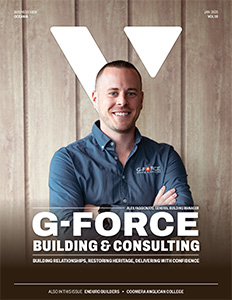
Click The Cover To View Or Download The Brochure
AT A GLANCE
Who: G-Force Building and Consulting
What: A leading builder that looks to further innovation
Where: Richmond, South Australia
Website: www.gforcebc.com.au
 This information will never be shared to third parties