

Building a Village of Learning From Baptism to Beyond
An Education Based on Core Values and a Sense of Community
In a rapidly growing pocket of New South Wales’ Central Coast, MacKillop Catholic College is evolving just as quickly as the community it serves. Located in Warnervale—an area experiencing significant residential development and population expansion—the Catholic primary through secondary college is only 22 years old, yet it is already one of the largest schools in the region, with a current enrollment of roughly 1,600 students.
Under Principal Tanya Appleby, appointed at the start of 2024, MacKillop has entered a new era defined by ambitious growth, major structural change, and a deeply intentional vision built around a powerful idea: schools should not simply educate students—they should accompany families.
At the heart of that vision is MacKillop’s renewed focus on developing “courageous, compassionate, and future-ready students.” But what distinguishes this approach is the way the school is positioning itself as an ecosystem that begins well before formal schooling starts.
For MacKillop, the journey of accompaniment begins at the baptismal stage, creating the first point of engagement with families when children are newborns or toddlers. That early connection is strengthened through opportunities that welcome families onto campus long before a child is old enough to enrol—such as parent and child programs, playgroup experiences, and community involvement designed to build belonging from the very beginning.
Looking ahead, MacKillop hopes to deepen this early-learning pathway further with the development of an on-site preschool, targeted for around 2027. While growth is a clear priority, the school’s intent is not to become larger for size alone. With projections to reach 2,200 students, MacKillop is planning for scale while working to ensure the student experience remains personal, relational, and deeply supported.
Restructuring a Large School Into Smaller Schools
A key leadership challenge at MacKillop is balancing size with intimacy. As enrolment increases, the risk is that students feel anonymous or disconnected in a school environment that becomes too large to navigate socially or emotionally. In response, MacKillop has adopted a “school within a school” model, dividing its structure into four smaller, more relational sub-schools.

The planned preschool will operate as its own entity. Beyond that, a junior school model will support students from Kindergarten to Year 4, while a middle school approach—less common in Australian contexts, but widely used internationally—will span Year 5 through Year 8.
A senior school will then run from Year 9 through to Year 12 and beyond, extending into what MacKillop describes as post-school learning, recognizing that some students benefit from staying in a supportive school environment longer than the traditional graduation age. This approach acknowledges an often-overlooked truth: not all learners progress at the same pace, and time can be a critical factor in maturity, confidence, and readiness for work or further study.
New Horizons: Reimagining Pathways for Disengaged Learners
Among the most significant initiatives under development is New Horizons, a program intended to support students who have become disengaged from learning around the Year 9 stage. Rather than allowing these students to drift, struggle, or eventually exit the education system, MacKillop is designing a tailored learning environment—a “small school within the school”—where curriculum and experience are redesigned to meet students where they are.
The goal is practical and outcomes-driven: create pathways that reconnect young people with purpose, enable them to complete schooling successfully, and fast-track them into employment by 17. New Horizons reflects a broader shift in contemporary education: recognising that student success is not one-size-fits-all, and that schools must redesign their structures and programs to support diverse learner needs rather than expecting every learner to fit a single model.
Transition and Parent Engagement: “Concierge” Roles for Belonging
To strengthen continuity across this expanded ecosystem, MacKillop has introduced new support roles designed to accompany students and families through every stage. Two standout positions are the Transition Coordinator and the Parent Engagement Officer, described as “concierge roles” in the learning journey.
These roles are designed to provide a warm entry point for families at any stage, whether a student begins at a traditional enrolment period or arrives mid-year due to relocation, employment changes, or family circumstances. With industries like mining influencing mobility in the region, MacKillop’s model aims to ensure no student arrives feeling like an outsider. Instead, the school seeks to maintain ongoing support—from first introduction to graduation and beyond—so families feel known, connected, and guided.
Staffing for Growth and Inclusion
MacKillop currently employs around 180 staff, including teaching and non-teaching roles. As the school grows, Mrs. Appleby anticipates expansion across multiple areas: more transition and accompaniment personnel, increased operational capacity to support a larger student body, and importantly, a stronger focus on inclusive education.
The next phase of staffing is expected to include more learner diversity teachers to support students who are neurodiverse or have complex learning needs, as well as those who will thrive through alternative pathway programs like New Horizons. The overarching strategy is capacity-building—not only for students, but for staff as well—because the demands of contemporary education increasingly require agility, flexibility, and broader learning delivery skills than traditional role definitions once required.
Catholic Identity and Faith Formation as the Moral Center
As a Catholic school, MacKillop’s mission is inseparable from faith formation and values-based education. Mrs. Appleby described a belief that every child is “the face of Christ before us,” reinforcing the school’s focus on dignity, love, and accompaniment. In MacKillop’s model, faith is not confined to religious instruction; it becomes the moral framework through which community is built, differences are respected, and students are encouraged to become ethical, service-oriented citizens.
This mission is expressed not only in how the school teaches, but in how it engages with the broader community. Catholic social justice, described as “Christian faith with rolled-up sleeves,” becomes a lived experience through partnerships and programs designed to place students into real contexts of service and empathy.
Community Partnerships: Social Justice in Action
MacKillop’s partnerships extend across nonprofit organisations, aged care, women’s shelters, refugee support networks, service groups, and local sporting communities. Students participate in intergenerational initiatives with nursing homes, outreach efforts that support vulnerable populations, and structured service programs where engagement is recognised and rewarded through a tiered points system that encourages sustained contribution.
The school also actively connects with surf clubs, recognising that coastal living requires practical skills like surf safety and understanding tides—an example of how MacKillop blends local context into student development. From sports engagement to service programs, the aim is to ensure students understand school as preparation not only for personal success, but for meaningful participation in the world around them.
Capital Investment and a Major Master Plan
MacKillop’s growth trajectory requires large-scale infrastructure planning. The school is currently working within an extensive master plan that begins next year, including the demolition and rebuild of the existing primary school space to create facilities “fit for purpose” for future enrolment. The plan also includes the prospective preschool build that will operate as its own entity but still connected to the College curriculum continuum in addition to the inclusion of faith formation for pre-school aged children. MacKillop is looking to a broader vision for the campus as a community hub—not simply a school site.
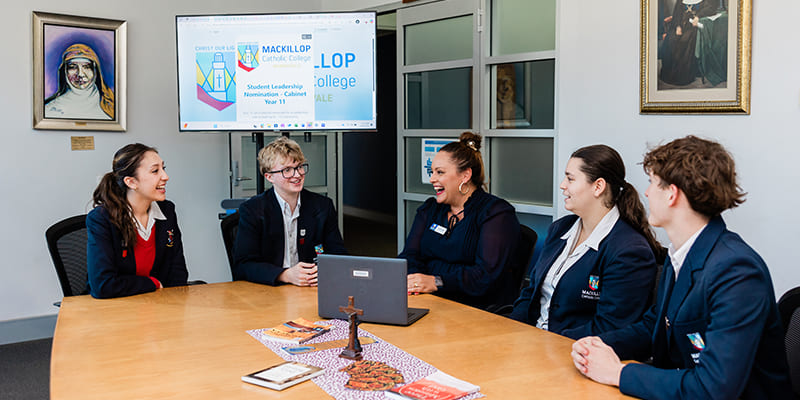
With a church located on-site, MacKillop already functions as a gathering place for faith and community life. The school is now exploring ways to extend that role by opening underutilised spaces and grounds to broader community use, including sport and recreation, building what Mrs. Appleby described as a “one-stop shop” ecosystem for faith, learning, relationships, and wellbeing.
Technology as an Enabler of Transparency and Learning Access
Technology infrastructure is central to MacKillop’s strategy, not only for learning delivery but for parent engagement and transparency. The school has invested in new learning platforms to “open the digital doorway” to parents, allowing families to view what is being taught, access resources and vocabulary, understand assessment expectations, and communicate more easily with teachers. Beginning in 2026, this access will extend from Year 5 through Year 12, signalling a major shift away from the traditional “closed classroom door” approach.
Technology also supports flexibility for students whose learning is interrupted by travel, sport, or family circumstances. Through asynchronous access, students can remain connected to their class learning wherever they are. The school is also leaning into ethical AI use—supporting students to understand what constitutes original work, how to acknowledge AI-supported learning, and how tools like voice-to-text can support learners with accessibility challenges.
A key strategic decision has also been made to transition students from iPads to laptops from Year 5 onward, positioning them for a Microsoft-based environment aligned with modern workplace expectations and blended learning models.
Leadership Driven by Vocation and Research
Mrs. Appleby’s leadership is anchored in a deep personal commitment to education. She described herself as “born a teacher,” and spoke passionately about education’s power to change lives—helping young people see beyond limitations, discover potential, and grow into responsible, respectful, contributing adults.
Her pathway includes training at Sydney University, experience in both primary and secondary contexts, extensive postgraduate study, and leadership roles in regional and boarding school settings.
Her most recent master’s degree in educational research explored teacher standards and the differing experiences of regional versus city educators—work that has shaped her commitment to regional schooling and her belief that leadership must be grounded in lived experience.
What Makes a Well-Managed School
Mrs. Appleby outlined what she believes defines a well-managed school. First, “people before paper”—a principle that places human wellbeing, capacity, and relationships at the center of leadership and decision-making. Second, fiscal responsibility and sustainability, including building financial understanding not only in executive leaders but in middle leadership as well.

Principal Tanya Appleby
A Third Pillar represents clear systems of practice—policies, procedures, governance, and strategic planning—anchored by accessible, technology-supported “single points of truth,” especially critical in child safety and risk environments.
MacKillop College is growing quickly, but its strategy is not growth at all costs. It is growth with intentionality: building a structure where students don’t get lost, families are accompanied, learning pathways widen rather than narrow, and the school itself functions as a community village—formed by faith, grounded in service, and designed to carry young people from their earliest beginnings through to confident futures.
Click The Cover To View Or Download The Brochure
AT A GLANCE
Who: MacKillop Catholic College
What: A leading school that is embracing growth and putting students first
Where: Warnervale, NSW, Australia
Website: www.mccwdbb.catholic.edu.au
PREFERRED VENDORS/PARTNERS

Innovateq Australia PTY LTD – www.innovateq.com.au
Established in 2008, Innovateq has become a premier national provider of IT, AV, and digital signage solutions across Australia and New Zealand. Delivering end-to-end, client-focused services, Innovateq blends innovative technology
partners, in-house design, and single-point project management to deliver customised outcomes backed by proven expertise and ongoing support.

 This information will never be shared to third parties